

An ecommerce retargeting strategy step by step is a systematic method for re-engaging visitors who left your store without buying, using targeted ads across Meta, Google, and YouTube to recover lost sales. Most ecommerce stores lose over 95% of visitors on the first visit. The difference between stores that recover those visitors and those that don’t comes down to three things: precise tracking, surgical audience segmentation, and creative that matches where each shopper is in their buying cycle. This guide walks you through every stage, from technical setup to ongoing optimisation, using tools like Meta Pixel, Conversions API, and Google Ads Customer Match.
What tools and platforms do you need for ecommerce retargeting?
Effective Meta ecommerce retargeting requires combining Meta Pixel, Conversions API, and synced product catalogs on Shopify. This trio forms the foundation of a full-funnel system, not just a basic tracking snippet. Without all three working together, your audience data is incomplete and your ads will underperform from day one.
Here is what you need in place before launching any retargeting campaign:
- Meta Pixel and Conversions API (CAPI): Install the Meta Pixel through Shopify’s native integration, then layer on CAPI for server-side event tracking. High Event Match Quality through hashed identifier passing significantly improves audience matching, which directly lifts campaign performance.
- Product catalogue sync: Connect your Shopify product feed to Meta Commerce Manager. Dynamic product ads require a synced catalogue to display the exact items a shopper viewed or abandoned. Standard retargeting without a catalogue is possible but measurably less effective.
- Google Ads remarketing tag and Customer Match: Add the Google Ads global site tag to your Shopify store and upload your customer email lists. Customer Match is the gold standard for first-party data targeting in Google Ads, using AI predictive modelling to find similar high-value customers from your uploaded lists.
- Audience thresholds: Google Display requires a minimum of 100 active users in a list before ads can serve. Build enough traffic before expecting retargeting to deliver meaningful volume.
| Platform | Tracking tool | Minimum audience size |
|---|---|---|
| Meta Ads | Pixel plus CAPI | 1,000 matched users recommended |
| Google Display | Remarketing tag | 100 active users |
| Google Search | Customer Match | 1,000 active users |
| YouTube | Remarketing tag | 1,000 subscribers or viewers |
Pro Tip: Set up CAPI before you launch any paid traffic. Fixing tracking after campaigns are live means weeks of corrupted data that cannot be recovered.
How to segment and build your retargeting audiences step by step
Audience segmentation is where most ecommerce retargeting campaigns either win or waste budget. Lazy retargeting fails by showing identical ads to everyone without segmentation or frequency control. The fix is building distinct audience tiers based on intent and recency.
Here is the four-tier audience structure Moormarketing recommends for ecommerce stores:
- Checkout abandoners (highest intent): These visitors added items to cart and reached the checkout page but did not complete the purchase. Target them within 0 to 3 days with a direct call to action. Use urgency messaging and, if margins allow, a small incentive like free shipping.
- Cart abandoners: Shoppers who added to cart but did not reach checkout. Start contact within 24 hours. Recency-based messaging improves retargeting efficiency significantly, with the 0 to 3 day window being the most aggressive and highest converting.
- Product page viewers: Visitors who viewed specific products but did not add to cart. These require warmer messaging that builds desire rather than urgency. Dynamic product ads work particularly well here because they surface the exact items the shopper viewed.
- Past purchasers: Existing customers are your highest-value retargeting audience for upsells and repeat purchases. Segment by product category purchased and serve complementary product ads or loyalty offers.
Recency windows matter as much as the tier itself. The recommended splits are: 0 to 3 days for aggressive direct response, 4 to 7 days for warm reminder messaging, 8 to 14 days for incentive-led ads, 15 to 30 days for urgency and scarcity, and beyond 30 days for nurture content or exclusion from active campaigns.
Exclusion audiences are equally critical. Campaigns must exclude recent purchasers and non-customer traffic to avoid wasted budget and a poor user experience. Always exclude anyone who completed a purchase in the last 7 to 14 days from your cart abandonment campaigns.
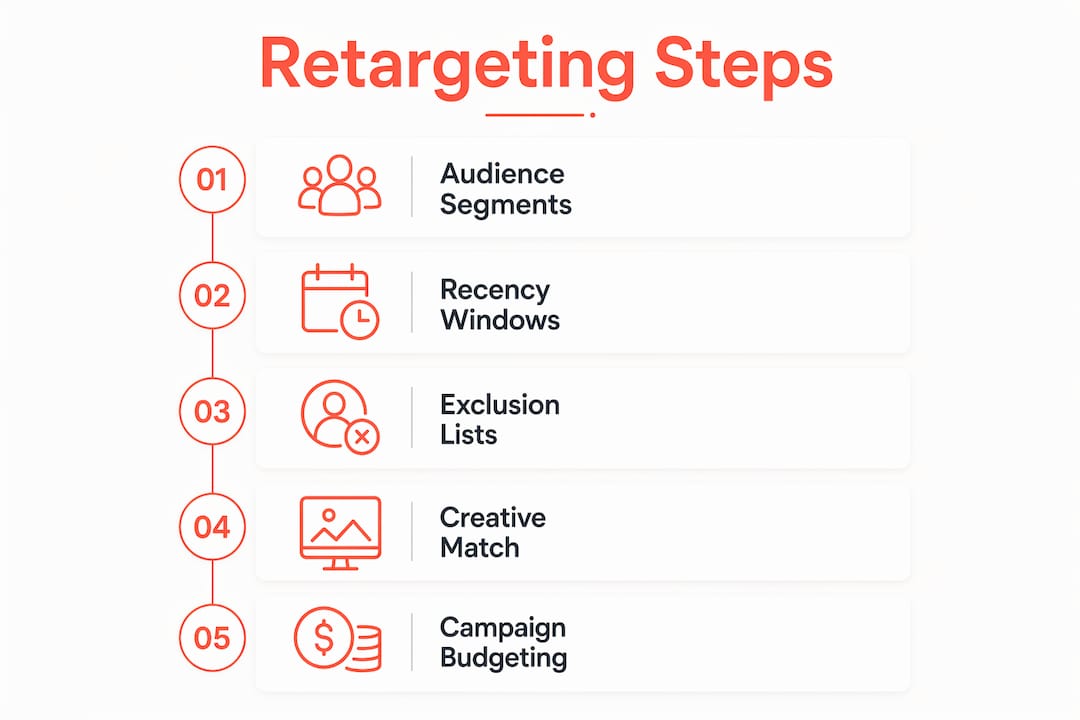
For advanced segmentation on Meta, the audience segmentation guide for Meta Ads covers custom combination rules that let you build hyper-specific audiences by combining multiple behavioural signals.
Pro Tip: Create a “recent purchasers” exclusion list and apply it to every retargeting campaign you run. Showing cart abandonment ads to someone who already bought is one of the fastest ways to damage brand trust.
What ad creative works best for each retargeting segment?
Creative is where retargeting either converts or annoys. The rule is simple: match the ad message to the intent level of the audience seeing it. Generic ads shown to all visitors regardless of behaviour are the primary cause of ad fatigue and wasted spend.

For checkout abandoners, use a direct call to action with minimal friction. The ad copy should reference the specific product or cart, include a clear “Complete your order” message, and link directly to the checkout page rather than the homepage. If you are using Meta dynamic ads, the catalogue will automatically populate the exact product the shopper left behind.
For product page viewers, the approach shifts to desire-building. Use lifestyle imagery, social proof like star ratings or review snippets, and copy that addresses common objections. Avoid discount offers at this stage because you are training shoppers to wait for a deal before buying.
For past purchasers, lead with new arrivals, complementary products, or a loyalty reward. These ads should feel like a personal recommendation, not a generic promotion. Syncing your Shopify catalogue with Meta allows you to serve category-specific recommendations based on what each customer previously bought.
Poor retargeting is consistently caused by generic ads, no frequency control, and no audience segmentation. Good retargeting is surgical segmentation matched to buying stages, with creative that speaks directly to where each shopper is in their decision process.
Pro Tip: Refresh your retargeting creative every two to three weeks. Even the best-performing ad loses effectiveness once frequency climbs above five impressions per user.
How to structure and budget your retargeting campaigns across platforms
Campaign structure determines whether your retargeting spend is efficient or chaotic. Each audience tier should live in its own campaign with its own budget, not lumped together in a single ad set.
Retargeting budgets typically range from 15 to 25% of total ad spend, starting small before scaling. Begin testing with $5 to $15 per day per campaign and wait for 100 to 300 clicks before making optimisation decisions. Scaling too fast before you have data is one of the most common and costly mistakes in ecommerce ad retargeting.
Frequency capping is non-negotiable for protecting user experience and budget efficiency. Frequency caps differ by platform due to ad intrusiveness. The recommended limits are: Meta at 3 to 5 impressions per day, Google Display at 3 to 5 per day, and YouTube at 2 to 3 per week. Exceeding these thresholds produces diminishing returns and increases the risk of negative brand sentiment.
| Platform | Recommended frequency cap | Campaign duration |
|---|---|---|
| Meta Ads | 3 to 5 per day | 7 to 14 days per tier |
| Google Display | 3 to 5 per day | 14 to 30 days |
| YouTube | 2 to 3 per week | 14 to 30 days |
| Google Search | Not applicable | Ongoing with bid adjustments |
Cross-platform coordination matters more than most marketers realise. A shopper who sees your Meta retargeting ad and then encounters your Google Display ad the same day is more likely to convert than one who sees only a single channel. Sequence the messaging so Meta leads with the product reminder and Google reinforces with a review-led or offer-led creative.
For Google Ads Customer Match, use observation mode alongside your retargeting lists to gather performance data before switching to targeting mode. This approach lets you understand how your existing customer segments behave before committing full budget to them.
How to analyse and optimise your retargeting performance
Optimisation without the right metrics is guesswork. These are the indicators that actually tell you whether your retargeting campaigns are working:
- Return on ad spend (ROAS) by segment: Measure ROAS separately for each audience tier. Checkout abandoners should consistently outperform product viewers. If they do not, your creative or landing page has a problem.
- Conversion rate by recency window: Compare conversion rates across your 0 to 3 day, 4 to 7 day, and 8 to 14 day windows. This tells you where your messaging is losing momentum and where to concentrate budget.
- Frequency and impression data: When frequency climbs above five on Meta without a corresponding lift in conversions, it is time to refresh creative or tighten the audience window.
- Event Match Quality (EMQ) on Meta: Low EMQ means your pixel and CAPI are not passing enough identifiers. Improving EMQ by adding hashed email, phone, and browser data directly improves audience matching and campaign delivery.
- A/B testing cadence: Test one variable at a time, either headline, image, or offer. Run each test for at least seven days before drawing conclusions. Retargeting window length should also be tested against your product’s buying cycle. Shorter windows suit impulse purchases; longer windows suit considered purchases like furniture or electronics.
Scale what works by increasing budget on winning audience and creative combinations by no more than 20% per week. Prune campaigns where ROAS has been below target for two consecutive weeks.
Key takeaways
A successful ecommerce retargeting strategy requires precise tracking, intent-based audience segmentation, and creative matched to each buying stage across Meta and Google.
| Point | Details |
|---|---|
| Build the technical foundation first | Install Meta Pixel, CAPI, and sync your Shopify catalogue before launching any campaign. |
| Segment audiences by intent and recency | Separate checkout abandoners, cart abandoners, product viewers, and past purchasers into distinct campaigns. |
| Match creative to buying stage | Direct CTAs for high-intent audiences; desire-building content for early-stage visitors. |
| Apply frequency caps on every platform | Cap impressions at 3 to 5 per day on Meta and Google Display to prevent ad fatigue. |
| Optimise with segment-level ROAS | Measure performance per audience tier and scale winners by no more than 20% per week. |
What most retargeting guides get wrong
Most retargeting guides treat setup as the hard part and optimisation as an afterthought. In my experience working with ecommerce brands across categories from toys to furniture, the setup takes a day. The real work is everything that comes after.
The brands that consistently recover abandoned carts and grow repeat purchase revenue are not the ones with the biggest budgets. They are the ones who treat retargeting as a precision instrument rather than a broadcast channel. I have seen stores spending $50 a day on retargeting outperform competitors spending $500, purely because their segmentation was tighter and their creative was specific.
The most common mistake I see is running a single retargeting campaign with one ad set and one creative for all website visitors. That approach ignores the enormous difference in intent between someone who spent 30 seconds on a category page and someone who reached the payment screen. Treating them the same is not just inefficient. It actively damages your brand with the high-intent shopper who needed one more nudge, not a generic carousel ad.
The other underestimated factor is data quality. Brands that invest in getting their Event Match Quality above 7 on Meta and their Customer Match lists properly segmented in Google see measurably better results from the same budget. Tracking quality is not a technical detail. It is a revenue lever.
— Liza
Ready to build a retargeting system that actually converts?
Moormarketing works directly with ecommerce businesses to build retargeting systems that recover revenue rather than just run ads. The team has helped brands scale from zero to $2 million in monthly sales and turn underperforming ad accounts into consistent growth engines.
If you want a structured, hands-on approach to implementing what this guide covers, the ecommerce marketing workshops walk you through audience setup, creative strategy, and campaign structure with senior strategists, not junior account managers. For brands ready to build a full-funnel system, the ecommerce growth strategy service delivers a tailored retargeting framework built around your specific store, products, and margins.
FAQ
What is ecommerce retargeting?
Ecommerce retargeting is the practice of serving targeted ads to visitors who previously interacted with your store but did not convert, using tracking tools like Meta Pixel and Google Ads remarketing tags to re-engage them across platforms.
How much should I spend on retargeting campaigns?
Retargeting budgets typically range from 15 to 25% of total ad spend. Start with $5 to $15 per day per campaign and scale only after collecting 100 to 300 clicks of data.
How do I prevent ad fatigue in retargeting?
Apply frequency caps of 3 to 5 impressions per day on Meta and Google Display, refresh creative every two to three weeks, and exclude recent purchasers from active campaigns.
What audiences should I prioritise first?
Checkout abandoners deliver the highest return because they have the strongest purchase intent. Start your retargeting campaigns guide with this segment before building out product viewer and past purchaser audiences.
Does retargeting work without a large audience?
Google Display requires a minimum of 100 active users in a list before ads can serve, and Meta performs best with at least 1,000 matched users. Build organic and paid traffic first if your audience sizes are below these thresholds.