

An ecommerce quiz funnel is a short, guided quiz that matches shoppers to specific products, captures their email along the way, and feeds their answers into your marketing stack for follow-up. Done properly, it beats a generic product page because it removes choice paralysis and gathers zero-party data your ad platforms and email tools can actually use. It suits stores with a real catalogue to sort through. It’s a poor fit if you sell one product or three near-identical SKUs.
TL;DR:
- Quiz funnels excel for stores with large, complex catalogues where personalized recommendations significantly boost engagement and sales.
- Properly designed quizzes achieve around 65% completion and can convert approximately 37.6% of starters into leads, surpassing typical opt-in forms.
- Critical stages like the hook, question flow, email capture, and results page directly impact funnel performance, requiring careful optimization.
- Key integrations include live catalogue sync, email platform data linkage, and detailed event tracking to ensure reliable reporting and attribution.
- Building and maintaining a quiz funnel involves costs for software, development, and ongoing updates, with larger catalogues benefiting from professional agency support.
Table of Contents
- Why quiz funnels convert better than product pages
- What happens between a click and a purchase?
- How do you build a quiz funnel that actually converts?
- Which integrations actually make a quiz a funnel?
- What metrics actually prove a quiz funnel is working?
- Common mistakes that quietly kill your results
- Legal and privacy considerations for quiz data
- What does a quiz funnel actually cost to build and run?
- How long does it take to launch a quiz funnel?
- How do you write quiz questions people actually want to answer?
- Building it yourself or bringing in help
- Ready to turn quiz clicks into quiz revenue?
- Sources
- FAQ
Why quiz funnels convert better than product pages
A shopper staring down 40 near-identical moisturisers doesn’t feel spoiled for choice. They feel stuck. That’s the behavioural problem a quiz solves: it takes a wide catalogue and narrows it to a small, personally relevant shortlist in under two minutes. Once someone has answered five questions about their skin, their goals, or their budget, they’ve invested effort. Behavioural economists call this the commitment and consistency effect, and it’s a big part of why quiz takers convert at higher rates than browsers landing straight on a collection page.
The second reason is data, not psychology. Every answer a shopper gives you is zero-party data, information they’ve volunteered directly rather than information you’ve inferred from browsing behaviour or scraped from a pixel. That’s gold for segmentation: you can send a customer with “oily skin, budget under $50” a completely different email sequence to someone who ticked “dry skin, no budget limit.” Over a customer’s lifetime, that segmentation tends to lift average order value and repeat purchase rate, because the offers they see actually match what they told you they want.
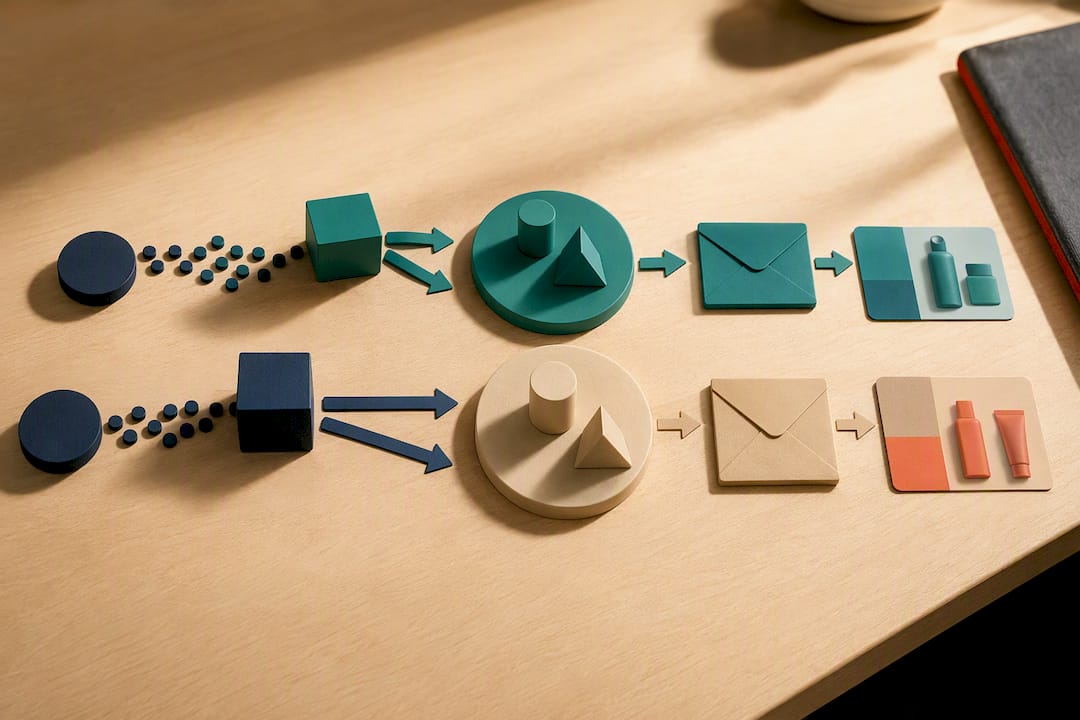
The numbers back this up. A quiz funnel is a four-stage system covering the quiz itself, email capture, product recommendation and a triggered email flow, and when all four stages are wired up correctly it can convert roughly 37.6% of quiz starters into leads, with around 65% of people who start a quiz finishing every question. That completion figure matters because it tells you the format itself isn’t the barrier. Poor question design is.
Where quizzes deliver the biggest wins:
- Beauty and skincare, where product choice depends on skin type, concerns and goals
- Supplements and nutrition, where dosage and formulation depend on individual factors
- Home fragrance and wellness, where personal preference is hard to browse for
- Apparel and footwear, where fit and style preference narrow a large catalogue fast
- Pet products, where breed, age and size drive very different recommendations
Quick benchmark: Interact’s data, cited in the UseKinetic guide, puts quiz completion around 65% and lead conversion near 37.6% of starters, well above typical opt-in form conversion rates.
Where quizzes don’t help: a single-SKU store, a niche B2B product with one obvious buyer path, or a catalogue so small that a filter dropdown does the same job for free. If your entire range fits on one screen, you don’t need five questions to sort it.
What happens between a click and a purchase?
A quiz funnel earns or loses revenue at five distinct points, and most underperforming quizzes fail at one specific stage rather than everywhere at once.
- The hook. This is the landing moment, whether it’s a homepage banner, a paid ad, or a popup. Its only job is to sell the quiz itself with a specific promise (“Find your perfect mattress firmness in 60 seconds”) rather than a vague one (“Take our quiz”). Weak hooks are the single biggest reason for low start rates, because shoppers won’t commit two minutes to something that sounds generic.
- The quiz. Question flow and progress UX decide whether people finish. A visible progress bar, one idea per screen, and a total of three to seven questions with five as the usual sweet spot keep completion high. Longer quizzes need a genuinely strong payoff to justify the extra taps.
- Email capture. This is placed either partway through (to reduce fatigue and pre-warm the list even if someone abandons) or right before the results reveal (to maximise capture rate at the cost of some completion). Both patterns are common; the right one depends on whether you value volume or quality more.
- The results page. This is where the funnel either earns its keep or falls flat. A hero product recommendation needs a clear “why this fits you” rationale tied directly to the shopper’s answers, a prominent add-to-cart button, and two or three secondary picks for people who want options. A results page that just lists five products with no explanation defeats the entire purpose of asking questions.
- The post-quiz email flow. This is the compounding part most stores skip. A triggered sequence that references the shopper’s specific answers (“Since you told us your skin runs dry in winter…”) converts far better than a generic newsletter blast, because it proves you were actually listening.
Each stage has its own failure mode. A weak hook kills start rate. A clunky quiz kills completion. Bad capture placement kills email volume. A generic results page kills quiz-to-cart conversion. And a lazy follow-up flow kills the long-term revenue the whole exercise was built to generate. Diagnosing which stage is broken, rather than assuming the whole funnel is bad, is the fastest way to fix it.
How do you build a quiz funnel that actually converts?
Before writing a single question, decide the one commercial decision the quiz needs to solve. “Help the shopper find the right product” is too vague. “Match a first-time buyer to the correct mattress firmness within their budget band” is a goal you can design questions and logic around.
Question design rules that hold up in practice:
- Ask about one variable per question. Combining “what’s your skin type and budget?” into a single question muddies your mapping logic later.
- Use image-based answers wherever the choice is visual (colour, style, room type); use text for anything that’s a fact about the shopper (age range, goal, frequency of use).
- Stick to three to seven questions, with five as the sweet spot. Fewer than three rarely feels personalised; more than seven starts costing you completions.
- Order questions from easy and low-stakes to more specific. Starting with “what’s your name” before anything interesting kills momentum.
Mapping answers to products: three approaches
| Method | How it works | Best for |
|---|---|---|
| Tags | Each answer adds a product tag filter (e.g. “dry skin” → tag match) | Small catalogues, simple logic |
| Metafields | Answers map to structured product attributes stored as Shopify metafields | Catalogues with rich, consistent attribute data |
| Weighted scoring / voting | Each answer assigns points to products or tags; highest score wins | Larger catalogues with overlapping attributes |
Recommendation logic varies by system, and voting or scoring engines generally scale better than rigid branching trees once your catalogue grows past a handful of products, because products often qualify for more than one answer path. A branching if-this-then-that tree gets unmanageable fast once you’re juggling more than a couple of dozen SKUs with overlapping attributes.
Pro Tip: Resist the urge to build a deep branching logic tree just because it feels more “custom.” A scoring system where each answer adds points to relevant products is easier to maintain, easier to debug when a recommendation looks wrong, and scales better as your catalogue grows.
Shopify implementation checklist:
- Confirm your quiz app or theme embed pulls live catalogue data (stock, price, images) rather than a cached snapshot, so results never show a sold-out item.
- Set up product tags or metafields that match your quiz’s scoring logic before writing a single question.
- Build a consistent add-to-cart link pattern from the results page so every recommended product adds correctly, including variant selection.
- Decide early whether you’re using a dedicated quiz app or building the flow directly in-theme. Apps are faster to launch and easier to maintain for non-developers; in-theme builds give you more control over design and page speed but need ongoing developer support.
Which integrations actually make a quiz a funnel?
A quiz without the right plumbing is just a fun distraction. What makes it a funnel is the pipe running from quiz answer to marketing action.
The integrations that matter most:
- ESP sync. Quiz answers should write into your email platform (Klaviyo and similar tools are the common choice) as named profile properties, for example
skin_type: dryorgoal: weight_loss, not buried in a free-text note field. This property-level sync is what lets you build triggered flows that actually reference what someone told you. Skip this step and you’ve built an expensive popup, not a funnel. - Shopify catalogue sync. The quiz needs to pull live SKUs, current prices and current images directly from your store. A quiz recommending a discontinued product or the wrong price erodes trust instantly, and it’s one of the most common technical failures in poorly maintained quizzes.
- Event-level tracking. You want quiz starts, question-level drop-off, completions and result-page clicks tracked as distinct events, not lumped into one generic “quiz interaction” tally. Server-side tracking is increasingly worth considering too, since ad platforms lose more pixel-based signal each year and vendor comparisons regularly flag server-side tracking and catalogue sync as key technical differentiators for reliable attribution.
- Multi-surface deployment. Beyond the website, consider whether the quiz needs to work embedded in an email (a shortened version linking through to the full flow) or as a standalone landing page for paid traffic. Each surface has different constraints on load speed and interactivity.
Get these four right and a quiz funnel becomes something you can report on with confidence rather than something you hope is working.
What metrics actually prove a quiz funnel is working?
Five numbers tell you almost everything about a quiz funnel’s health, and these are the metrics worth tracking as your baseline set.
- Start rate: quiz starts divided by page visitors. Tells you whether your hook is doing its job.
- Completion rate: quiz completions divided by quiz starts. A healthy quiz sits above 70%; anything lower points to a question, length, or UX problem.
- Email capture rate: emails collected divided by quiz starts (or completions, depending on where you gate). This is your list-growth engine.
- Quiz-to-cart rate: add-to-carts from the results page divided by completions. This is where you find out if your recommendation logic is actually convincing.
- Revenue per quiz start: total quiz-attributed revenue divided by total starts. The single number that tells you whether the whole exercise pays for itself.
Set these up properly and every one of them should be trackable through GA4 events, your Shopify order data, and your ESP’s flow reporting, cross-referenced rather than trusted on their own. A dedicated ecommerce metrics framework helps here, because quiz numbers mean little in isolation. Compare them against your non-quiz conversion rate and AOV, not against some universal industry average, since paid traffic and organic traffic will always report differently. Paid visitors tend to convert lower on the quiz itself but often carry higher intent once they finish; organic and email traffic usually completes at a higher rate but starts less often.
When something looks off, check start rate first, then completion, then quiz-to-cart, in that order. A broken hook (low start rate) can hide a perfectly good quiz. A great hook feeding a clunky quiz wastes traffic you already paid for.
Quick benchmark: industry guides generally treat a completion rate above 70% as healthy for a well-built quiz funnel; anything meaningfully below that usually points to question count, wording, or mobile UX friction rather than a traffic quality problem.
Common mistakes that quietly kill your results
- Overcomplicated branching logic. A quiz that routes shoppers through dozens of unique paths based on combined answers is a maintenance headache, and voting or scoring systems generally hold up better as your catalogue grows, since most products qualify against more than one attribute.
- The wrong gating decision. Gating the result behind an email form captures more addresses but reduces completion, while showing the result immediately and offering to email it as a backup balances the two reasonably well. Test both on a genuine traffic split rather than assuming one is universally right.
- A weak results page. If the hero recommendation doesn’t explain why it matches the shopper’s answers, you’ve built a randomiser, not a personalisation engine.
- Ignoring mobile UX. Most quiz traffic arrives on a phone. Tiny tap targets, slow-loading image answers and multi-line questions that wrap awkwardly all quietly bleed completion rate.
- Never trimming a bad question. One confusing or redundant question can drag down your entire completion rate, and removing a single weak question often lifts results more than a full redesign would.
Pro Tip: Before you touch design or logic, run a simple test: watch five real people take your quiz on their own phone without guidance. The question where they hesitate or ask “wait, what do you mean?” is almost always the one costing you completions.
Once the basics are solid, prioritise experiments in this order: test hero result layout first (does the rationale text actually get read?), then test your gating approach (email-before vs email-after), then test progressive profiling (asking for name and email separately rather than together). Each of these tends to move the needle faster than a full quiz redesign.
Legal and privacy considerations for quiz data
Collecting zero-party data through a quiz still counts as personal information collection, and the same privacy obligations that apply to any other data capture on your site apply here. If a question touches health, medical conditions, or anything sensitive (skin conditions, allergies, medication use), treat that answer with extra care, because sensitive personal information typically carries stricter handling requirements than a general preference question like favourite colour.
Practically, this means three things for a quiz funnel. First, your privacy policy needs to explicitly cover what the quiz collects and why, not just what your checkout collects. Second, your email capture step needs proper consent language before anyone is added to a marketing list, separate from simply “seeing their result.” A shopper finishing a quiz to see a recommendation hasn’t automatically agreed to receive marketing emails; that’s usually a separate opt-in. Third, if you’re syncing answers into an ESP as profile properties, make sure your data retention and deletion processes cover quiz-sourced data the same way they cover any other customer data, since a deletion request needs to remove it everywhere it landed.
None of this is exotic. It’s the same discipline you’d apply to any form on your site, just extended to a few extra data points. The stores that get burned are the ones treating a “fun quiz” as somehow exempt from the rules that apply to every other data collection point on their store.
What does a quiz funnel actually cost to build and run?
Costs split into three buckets: software, build time, and ongoing maintenance, and the gap between the cheapest and most expensive path is wide.
At the software end, dedicated quiz apps typically run on a monthly subscription that scales with your response volume or store traffic, on top of whatever you’re already paying for your ESP and Shopify plan. Building the same functionality directly in-theme avoids an app subscription but shifts the cost to developer time, both upfront and every time you want to change a question or add a product to the mapping logic.
Build time itself varies enormously depending on catalogue complexity. A five-question quiz mapping to a dozen products using simple tags is a different job to a scoring-based quiz mapping fifty answer combinations across two hundred SKUs. The mapping logic, not the quiz interface itself, is usually where the real time goes.
Maintenance is the cost most stores underestimate. Every time you add or discontinue a product, your quiz’s mapping logic needs updating, or shoppers start getting recommended products that no longer exist. Every seasonal promotion or catalogue refresh is a small task, not a one-off. Stores that treat a quiz as “set and forget” tend to see its performance quietly decay over six to twelve months as the underlying product mapping drifts out of sync with the real catalogue.
How long does it take to launch a quiz funnel?
A realistic timeline runs in four phases, and skipping any one of them is where most launches go wrong.
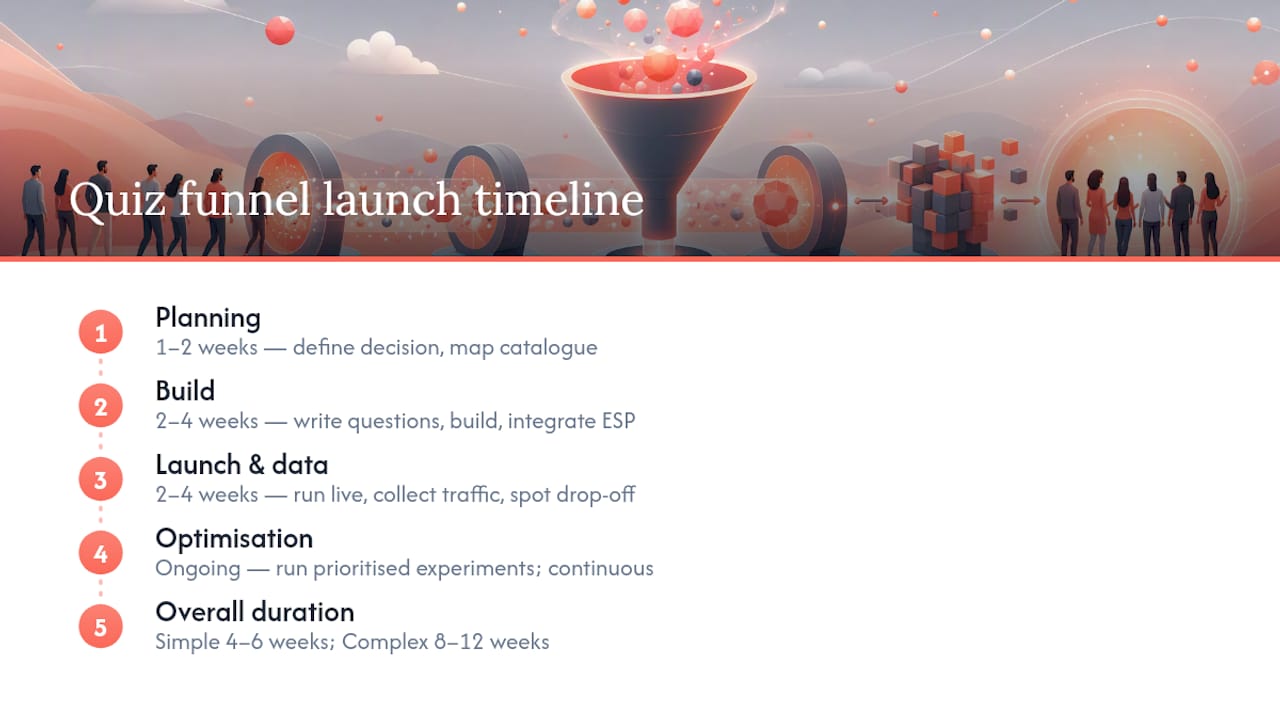
Planning (one to two weeks). Define the single decision the quiz solves, map your product catalogue against likely question answers, and decide your logic method (tags, metafields, or scoring) before writing any copy.
Build (two to four weeks). This covers question writing, results page design, the app or in-theme build itself, and wiring the ESP and analytics integrations. Catalogue complexity is the main variable here; a simple tag-based quiz on a small range builds faster than a scoring system across a large one.
Launch and initial data collection (two to four weeks). Run the quiz live but resist the urge to judge it in the first week. You need enough traffic through all five funnel stages to see where the real drop-off happens, not just anecdotal impressions.
Optimisation (ongoing). Once you have baseline completion, capture and quiz-to-cart numbers, start running the prioritised experiments covered earlier: hero layout, gating approach, and question trimming. This phase never really ends, because your catalogue and traffic mix keep changing.
Altogether, a straightforward quiz on a modest catalogue can go from planning to live traffic inside four to six weeks. A more complex, scoring-based quiz across a large catalogue with multiple ESP flows can reasonably take eight to twelve weeks before it’s fully optimised. Rushing the planning phase to hit a launch date is the single most common reason a quiz underperforms in its first quarter.
How do you write quiz questions people actually want to answer?
The best quiz questions feel like they’re being asked by someone who already understands the shopper’s problem, not by a form trying to extract data.
Start every question from the shopper’s point of view rather than your inventory’s. “What’s your biggest skin concern right now?” invites an honest answer. “Which product category are you shopping for?” just asks them to do your catalogue navigation for you, which is the exact friction a quiz is supposed to remove.
Keep the language conversational and specific to your audience. A skincare quiz for a younger demographic can use casual phrasing and playful image answers; a quiz for a technical or premium product (say, home theatre equipment or specialty coffee gear) needs answers phrased with enough precision that an informed buyer doesn’t feel condescended to. Match the vocabulary of your questions to how your actual customers describe their own problem, not to internal product jargon.
Order matters as much as wording. Open with a broad, easy, low-stakes question to build momentum (this is often where image-based answers work best, since they’re fast to scan and answer). Save anything that requires real thought, like budget range or specific goals, for the middle of the quiz once the shopper’s invested a little effort already. And always test your questions against real customer language, not marketing copy: if your product pages call something “hydration technology” but your customers just say “makes my skin less dry,” write the quiz question the way your customers actually talk.
Building it yourself or bringing in help
The decision between DIY, hiring an agency, or a hybrid approach mostly comes down to two variables: how complex your catalogue is, and how much of your traffic is paid versus organic.
A small catalogue with straightforward attributes and mostly organic or email traffic is genuinely a reasonable DIY project using an app and a weekend of question writing. A large catalogue with overlapping attributes, multiple traffic sources that each need different tracking, and an ESP flow structure that has to reference quiz answers correctly is a different scale of project, and that’s usually where a hybrid or fully managed approach earns its cost back faster than the time it takes to learn the mistakes yourself.
Some agencies work with growing ecommerce brands on exactly this kind of build: the strategy behind which questions actually matter, the conversion rate optimisation wiring on the results page, the ESP flow structure that turns quiz answers into ongoing revenue, and the paid traffic optimisation that decides which visitors are worth sending to the quiz in the first place. If you’re weighing up whether to tackle this in-house or get a senior strategist involved from the start, a short scoping call or a full store audit is usually the fastest way to find out which path actually suits your catalogue and traffic mix, whether that’s a focused engagement or something structured around a defined revenue sprint.
— Liza
Ready to turn quiz clicks into quiz revenue?
Moormarketing runs digital strategy the way senior strategists would want it run for their own store: hands-on, senior-led, and built around a defined revenue target rather than a vague retainer. Where most agencies hand your account to a junior and disappear into monthly reporting decks, every engagement here is built and reviewed by the strategist actually doing the work, on frameworks that have doubled revenue for existing brands and helped new ones launch into competitive markets.
If a quiz funnel is one piece of a bigger conversion problem on your store, that’s exactly the gap a structured engagement closes. The 12 Week DOUBLE Your Revenue Challenge is built for merchants who want an agency-led sprint rather than an open-ended retainer, covering ecommerce strategy, conversion rate optimisation, email flows and paid media in one coordinated push. For a lighter first step, the Convert More Customers service page walks through how Moormarketing approaches strategy, CRO and paid traffic for stores at your stage. Book a scoping call and find out which path fits your catalogue.
Sources
- Quiz Funnel: The Complete Guide to Ecommerce Sales
- Shopify Quiz Funnel: Build, Map & Measure (2026)
- Ecommerce quiz: what it is, types, and how it grows your store
FAQ
What Is an Ecommerce Quiz Funnel?
An ecommerce quiz funnel is a guided quiz that asks shoppers a few questions, captures their email, and then recommends specific products based on their answers. When wired correctly, it can convert around 37.6% of quiz starters into leads, well above a standard opt-in form.
How Many Questions Should a Product Quiz Have?
Most effective product quizzes use three to seven questions, with five being the common sweet spot. Fewer feels generic, and more than seven tends to hurt completion rates without adding much personalisation value.
Should I Gate the Quiz Result Behind an Email Form?
Gating the result increases email capture but reduces completion, while showing the result immediately and offering to send it by email balances both outcomes reasonably well. Testing both approaches on your own traffic is the only reliable way to know which suits your audience.
What’s a Good Completion Rate for a Quiz Funnel?
A completion rate above 70% is generally considered healthy for a well-built quiz. Anything meaningfully lower usually points to question wording, length, or mobile usability issues rather than a traffic quality problem.
Should I Build a Quiz Funnel Myself or Hire an Agency?
A simple catalogue with mostly organic traffic is a reasonable DIY project using a quiz app. A larger catalogue, multiple paid traffic sources, and ESP flows that need to reference quiz answers correctly usually make a hybrid or agency-led build, such as Moormarketing’s Convert More Customers service, pay for itself faster than a self-taught build.